
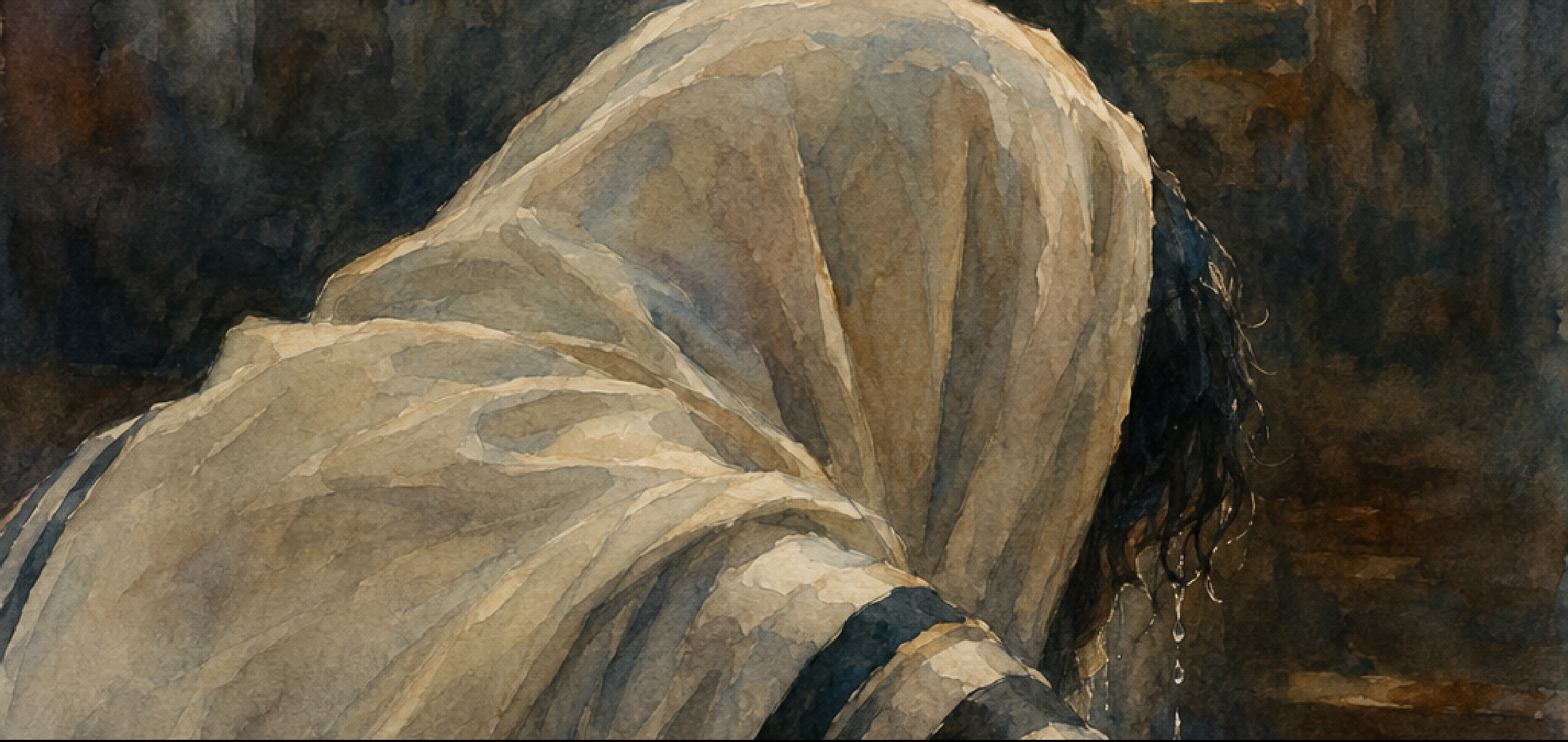
Erev Yom Kippur, minutes before Kol Nidrei. I'm sitting in my seat in the Beis Medrash, hunched over. My rebbe (he should be well!), Rav Yehuda Parnes, walks in and sees my face as he passes by me. He immediately stops and looks into my eyes.
"Eliav, it will be okay."
"How do you know?"
No speaking in third-person to my rebbe, as had been my custom with all my rebbeim since early adolescence.
No recognition at all of what my rebbe was trying to express to me.
Nothing but fear.
Because that's all that I felt.
Well, not precisely. Perhaps the word terror would be more precise.
Over the years my wife would grow accustomed to it. Elul would start and I would either be irritable or somewhat detached. Or both. Alternatively, I would completely ignore the fact that it was Elul, going about my life trying to ignore the sense of impending doom spreading within my gut. But it's hard to ignore the fact that it's Elul when you daven for the amud on the Yomim Noraim. You have to prepare the davening. Or you can procrastinate and deal with anxiety gnawing at you that you're not prepared to daven.
I did a lot of the latter.
Erev Yom Kippur was always the worst. Horrible stomachaches. We would have our seudah hamafsekes a couple of hours before the fast would start to compensate. And then I'd have to go to shul early because the nervous energy inside of me didn't allow me any rest. I was horrible to be around. In shul I was either literally alone or hiding under my Tallis.
Those tears during Tefillah Zakah? They were real. Was it real teshuva? I'm still not 100% sure how to define that. What I do know is that I experienced abject terror, convinced that I was doomed, a literal death sentence hanging over my head. I would beg HaShem for mercy, pleading for my life and those of my loved ones. I promised that I would improve in every area, desperately seeking any angle to convince HaShem that I was worthy of another year.
But I didn't truly believe that I was.
When I first heard my dear friend Rav Mordechai Burg use the term "Catholic Judaism" I felt an instant resonance with the concept. I am no expert on the intricacies of Christian theology. But on a basic level I understand that Catholicism is a rather grim approach to life. You are doomed, you are bad, repent, hell is the best you can hope for. (My apologies if I offend any Catholics with this; this really isn't about you.)
My experience of Elul was impacted by many factors. The simplest to explain are those based on my yeshiva experiences. The message I received is that Elul is a serious time, a time in which the entire briah is shaking in anticipation of the Great Day of Judgment. If you found money on the ground while walking down the street, there was no time to bend down and pick it up. DO TESHUVA.
It's unfair, however, to pin this all on what I heard in yeshiva. It was my own internal system that was receiving these messages. And that system was one that held a deep belief that I wasn't good enough. Frankly, the belief was that I would never be good enough. And around that belief were protective parts that took shape as anxiety, depression, perfectionism, an impressive ability to escape from myself and my feelings in myriad ways, and an equally impressive ability to produce under pressure that kept this whole system from crashing. (To this day my procrastination parts play a more central role than I'd prefer, and my ability to "wing it" continues to keep me afloat.)
An approach to Elul and the Yomim Noraim built on yirah alone found fertile ground within my internal system to sprout ever greater anxiety, gloom and doom. And despite years of therapy and working on my relationship with myself, others and with HaShem, I still found myself struggling year after year. Elul, Rosh Hashanah and Yom Kippur triggered all those anxieties and deep-seated fears in me. I continued to be sure of my impending doom; I suffered.
My journey to a different relationship with the Yomim Noraim has been long and is still ongoing. IFS has played a big role, helping me to better understand what has been and is going on inside my system and to work with those struggling parts. As I've learned to bring more and more compassion to all of these parts, there has been a great easing within the system.
Compassion alone wasn't enough, however. I've been zoche to build a close relationship with my Rov, Rav Tzvi HaCohen Davidovitch here in Ramat Beit Shemesh. A uniquely humble individual, he is someone with whom I can discuss any topic or anything going on in my life, and I have found his wisdom to be invaluable in my life and in my work as a therapist. As a Viznitzer Chossid, his approach to Rosh Hashanah, and hence to Elul, was drastically different from mine.
He helped me see that the central theme of Rosh Hashanah is the Coronation of the King. In the liturgy, the focus is clearly on that. While judgment is mentioned, it is almost ancillary. As the King ascends the throne He takes note of all that has taken place and makes determinations for the coming year. But the focus is the King, and we need to realize who the King is.
A dear friend put it to me as follows: sure, Rosh Hashanah is the day HaShem takes a good look at us, but He's not judging in the negative sense; He's checking in. How are you doing? How much have you grown this year? Where do you still need to grow? He's not out to get us; He's our biggest cheerleader.
Wow. That's different.
Sure, He's taking a close look at how I'm doing. But not because He's looking for excuses to condemn me to eternal damnation. He's actually my biggest supporter. He's rooting for my success.
He's not out to get us. He's checking in. He's our biggest cheerleader.
Learning the Ba'al Hatanya's piece Hamelech Basadeh was critical for me, but I had to learn it and relearn it numerous times over the years, each time my system a bit more open, a bit more trusting. Being exposed a bit to Breslev was also helpful (though I have yet to take a deep dive). The process has been one of making small mental shifts as my system adjusted emotionally to them, slowly learning to trust more and more that I am lovable, that I am redeemable, that I am, in my essence, good.
There are still echoes of the past as Elul approaches. There may still be moments that are difficult. (And that's okay.) I sometimes still struggle to reconcile various ma'amarei chazal with this more palatable (to me) approach to the Yomim Noraim. (And that's also okay.)
But as I approach Elul this year, I view it as a time in which the King is available in a way He rarely is. The King loves me more than I can possibly comprehend, and He is actively seeking a relationship with me. On Rosh Hashanah, I will once again proclaim Him my King, recommitting to my relationship with Him. Yes, He will take stock of all that I have and haven't done over the past year. And that judgment will be exact, as only He can do it. But the exacting judgment is being passed by a King who loves me, who cares for me, and who wants what's best for me. Whether I can understand what that means or not.