As a child, the Judaism I absorbed was often described in terms of what we were trying to avoid. Intermarriage, assimilation, indifference, these were not simply worst-case scenarios but the engines driving daily practice. To be Jewish meant to preserve Judaism, however amorphous that term became. For a curious young boy, this was perplexing, and ultimately frustrating. I felt as if I were being asked to write letters to a distant relative I had never met, lest the family become estranged.
Today I notice the same pattern in our communal conversations.
"We have to keep our children in the system."
"We're losing too many young people."
"Intermarriage is rising."
"We need stronger institutions."
"We have to make sure there are Jewish grandchildren."
None of these concerns are misguided. On the contrary, they reflect a people that has learned, through centuries of exile, persecution, and ultimately the Holocaust, that survival can never be taken for granted. And yet, if allowed to dominate our discourse, these concerns can silence another set of questions that is no less vital.
Imagine someone asking why you remain committed to Torah and mitzvos. If your first answer is, "Because otherwise Judaism might disappear," you have given a reason. But have you given the deepest one? Is Judaism simply an inheritance to protect, or is it a vision of human flourishing that the world desperately needs?
Oddly enough, I found a language for these questions in an unexpected place: a book on storytelling.
In The Anatomy of Genres, John Truby argues that every genre revolves around a different question about human existence. Romance asks how two people can build a life together. Science fiction explores what kind of civilization technology should create. And Horror asks perhaps the oldest question of all: how do we live knowing that death is inevitable?
Seen this way, Horror is far more than a literary category. It is a philosophy of life. In Horror stories the monster is never truly defeated. At best the heroes escape, and even if the monster dies, it returns in the sequel. Death is always waiting, and the goal is therefore not triumph but survival.
Truby contrasts this with what he calls Myth, not a false story, but the great heroic narratives that have shaped civilizations for millennia. Myth faces the same reality of death but arrives at a radically different conclusion. The mythic hero's battles with dragons and tyrants force him to discover his deepest responsibilities: to his people, to his world, and ultimately to his own soul. His inner transformation and sense of purpose let him transcend the fear of mortality.
Is Judaism simply an inheritance to protect, or a vision of human flourishing the world desperately needs?
That distinction sheds unexpected light on contemporary Jewish life. The Jewish people emerged from the twentieth century carrying profound wounds. After the Holocaust, concerns that had always existed within Judaism, survival, continuity, demographic strength, institutional preservation, naturally became central. In the shadow of Auschwitz, every Jewish marriage, every child, every yeshiva could be understood as an act of resistance against annihilation. Perhaps no thinker expressed this impulse more radically than Emil Fackenheim, whose famous "614th commandment" forbade granting Hitler any posthumous victories. For many Jews, existence itself became the most sacred task.
This response is understandable, even noble. Horror, after all, is not a mistake. The Torah itself commands, v'nishmartem me'od l'nafshoseichem. Survival is a mitzvah, and in a profound sense the horrific makes the heroic possible. But problems arise when Horror becomes not simply a response to danger but the dominant way we understand our Judaism.
This begins in the home. Children absorb not only the beliefs we teach but the emotional climate around them. If Judaism is presented mainly as something fragile, perpetually under siege, always one generation from disappearing, that atmosphere slowly becomes part of their inner world. Questions of meaning and connection quietly give way to questions of maintenance and continuity. At the institutional level, concern for how many young Jews remain within the system gradually eclipses concern for the kind of young Jews the system produces.
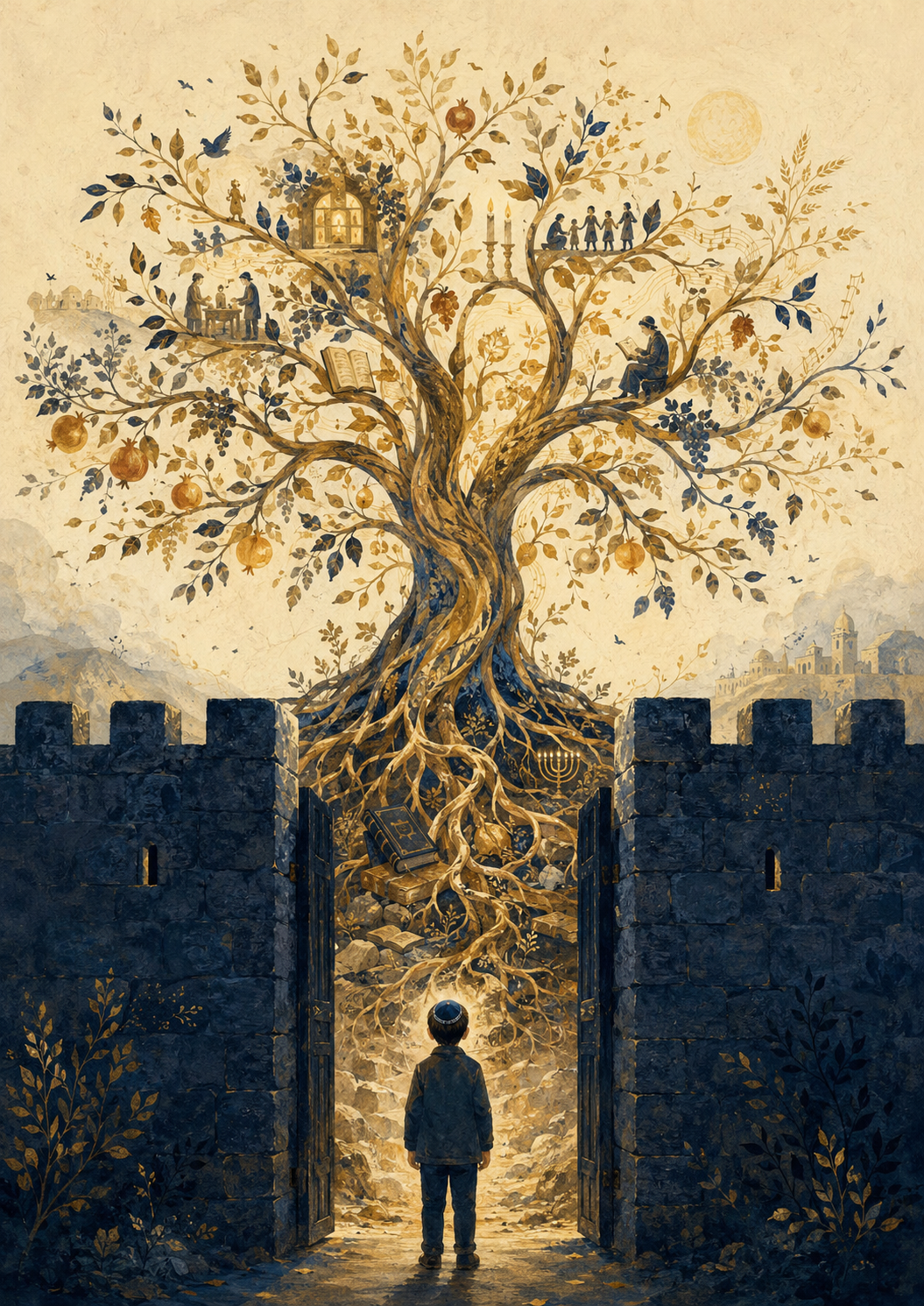
Judaism has always insisted on a proper relationship between Horror and Myth. Avraham Avinu was prepared to sacrifice his only son in service of the higher calling to which he had been summoned. In that moment, continuity itself ceased to be the highest value. The covenant rested not on biological persistence but on fidelity to a divine mission. The Akeidah was the triumph of Myth over Horror, and it became the foundation of Jewish history.
When we choose a higher calling over continuity itself, we restore the true foundation of Jewish history.
A more mythic Judaism would not abandon concerns about continuity; it would simply restore them to their proper place. We would introduce our children to that "distant relative" long before we introduced the fear of assimilation, letting a genuine sense of relatedness become the foundation of their Yiddishkeit. We would build schools and communities not only to keep Jews Jewish, but to cultivate the wisdom, courage, and moral imagination that let us become a light unto the nations.
The Alter of Novardok famously said, "I don't judge a yeshiva by how many good or bad students it has, but by what its students consider good or bad." What do today's students consider good? Do they carry a picture of tzidkus that feels alive and attainable? Is their Torah study a source of wonder? Can they imagine themselves as a force for good in their communities and beyond? Statistics cannot answer these questions, and they cannot even be asked while statistics remain our primary lens.
Ultimately, Myth may accomplish what Horror alone cannot. Communities animated by purpose and meaning become magnets for searching souls. Children who experience Judaism as a source of wonder and creativity naturally want to share it with the next generation. When people sense they are part of something dynamic and transformative, continuity largely takes care of itself. But before we can tell this better story, we have to reexamine the story our homes and institutions are already telling.
My rebbe, R' Shimon Green, would often open his shiur by noting the empty seats in the beis midrash. "The fact that there's still space, that people aren't banging down the doors to get in, is a sign that we still have work to do." Our institutions should be bursting at the seams, not merely so that Judaism exists tomorrow, but because of what it offers the world today.
The challenge before contemporary Judaism, then, is not simply to choose between Horror and Myth. We need both. It is to preserve the vigilance history has taught us while recovering the confidence to speak about humanity's highest possibilities. A story survives not only because it is preserved in books and manuscripts, but because people sense it is a story worth living. Today, perhaps more than ever, the world needs our story.
Questions for Reflection
Where has Horror been an important teacher in my life? Where might it have become my only teacher?
What emotional climate does my home create around Judaism?
What other genres would I like to bring into my Judaism, Romance? Adventure? Mystery? What questions lie at their heart, and how might they enrich my avodas HaShem?
When I ask my child, "How was school today?" what story am I likely to hear? What story do I hope to hear? What explains the gap?
If my life were a novel, what would readers hope the next chapter contained?