
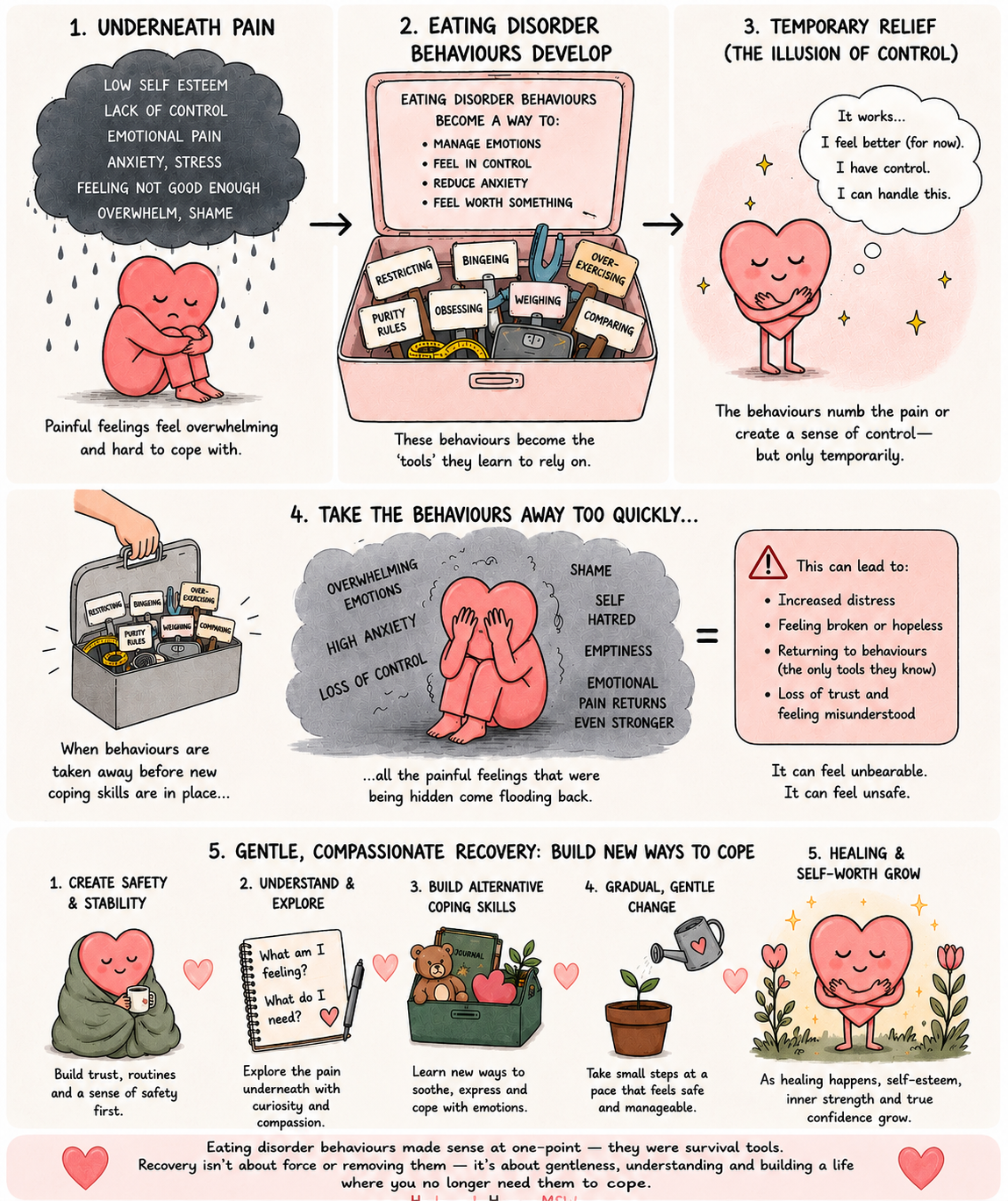
Over years of walking alongside clients, and through my own experiences of being human, I have come to realise that beneath even our most perplexing behaviours usually lies an attempt to survive. We are all wired to seek safety. Sometimes we find it in relationships, meaning, faith or connection; sometimes, when life feels overwhelming, we find it in places that eventually begin to hurt us. Eating disorders are one of the most powerful examples of this paradox. What appears from the outside to be "just about food" is actually an intelligent attempt by the nervous system to create order, relief or protection amid internal distress.
One of the greatest heartbreaks I witness professionally is how often these behaviours are misunderstood. I have sat with countless people who have been told to "just eat" or "just stop bingeing." When they couldn't, they were met with frustration, criticism or shame. Asking someone to abandon an eating disorder without first understanding what it has been protecting them from is like asking them to step out of a shelter before another place of safety exists.
When most people picture an eating disorder, they picture food. But that rarely answers the question people caught in one ask themselves over and over: If I know this is harming me, why can't I stop? The answer is that an eating disorder is never really about food. Most people know exactly what it is costing them and have fought it for years with willpower. Yet we don't keep repeating something that gives us nothing. Even behaviours that cause real suffering offer something in the short term: relief, comfort, escape, control, or a way not to feel something unbearable. That shift changes everything. Instead of asking, What is wrong with me? the question becomes, What is this doing for me?
Many people say their eating disorder appeared at a moment when they needed something. Life felt chaotic and restriction brought order. Loneliness felt unbearable and food brought comfort. The tragedy is what it eventually costs: what begins as relief gradually hardens into obsession, fear, shame and isolation. This is why we cannot treat the behaviour as though it were the whole problem. Take it away without understanding the safety it has been providing, and whatever it was holding back simply floods in.
None of this means an eating disorder only develops out of severe trauma or neglect. Plenty of people who develop one describe loving parents and stable, caring homes. We are shaped not only by what happens to us but by how we experience it. Bullying, illness, grief, feeling different, neurodivergence and the ordinary pressures of growing up can all shape how someone comes to relate to themselves and their body.
One of the most common struggles I encounter as an eating disorder therapist working predominantly within the frum community is how to navigate fasting. With the chagim and Yom Kippur approaching, it feels important to touch on this.
Fasting is complicated even for people who have no explicit difficulties with food or body image. For those who do, the stress often begins weeks or months beforehand.
An eating disorder is never really about food.
For some, food obsession grows as the fast goes on. They think more and more about the break-fast, knowing they are likely to binge, and the anticipation itself becomes consuming.
For others, the opposite happens. Not eating brings such a profound sense of control, sometimes even a high, that when it is time to break the fast they cannot bring themselves to eat, sometimes for days afterwards. Beginning to eat again feels like a loss and a failure, and food becomes a terrifying enemy. This is especially dangerous for people who have worked hard in recovery and prematurely decide they are ready to fast. Restrictive, anorexic parts can return in full force after being quiet for months or years. Sadly, many people relapse following a fast when, in reality, a Rav would gladly have given them a heter to protect their physical and psychological health.
For those whose eating disorder centres on bingeing or overeating, the struggle looks different. They become consumed by thoughts of food, running through endless permutations of what and how much they will eat, or telling themselves that having not eaten all day, they can eat more at the break-fast. By the time the fast ends, their nervous system is so activated that they cannot regulate. Anxiety, shame, comfort and relief become woven together in a confusing and painful experience.
Shabbat and Yom Tov meals bring their own battle. When a night meal is late and there will inevitably be a lot of food, painful decisions arise: Should I starve myself all day so I can "allow" myself to overeat tonight? Or honour my hunger, only to be overwhelmed with guilt in the evening? Sometimes they restrict all day only to overeat anyway, losing the very control they were trying to preserve. Times intended for joy and connection instead become frightening and, for some, profoundly traumatic.
This is where the nervous system comes in. It is always scanning for cues of safety and danger. When we feel safe and connected, we can think clearly, tolerate discomfort and stay present. When we feel overwhelmed, ashamed or alone, the nervous system reaches for whatever has previously helped it settle. For someone with an eating disorder, food behaviours have become that strategy.
This is why purely behavioural approaches so often fall short. Dietitians, meal plans, structured eating and CBT all have an important place, and nutritional rehabilitation is often essential. But if treatment changes the behaviour without asking what it has been trying to achieve, people are left flooded and dysregulated, and drawn straight back to the strategy that once helped them cope.
The aim of recovery is not simply to stop the symptom but to understand it. If restriction is how someone feels safe, what happens the moment it disappears? If bingeing is how someone survives loneliness, what holds them when food can no longer do that job? Those needs cannot be removed; they have to be met differently. Recovery is not merely the absence of behaviours. It is the gradual development of a nervous system that can tolerate emotions, relationships, uncertainty and vulnerability without needing the eating disorder to manage them. This is why my work sits at the intersection of trauma, attachment and eating disorders: it is the behavioural, the trauma-informed and the relational working together that creates the greatest opportunity for lasting change.
If you have never understood why diets, meal plans or simply trying harder have not been enough, I hope this offers some language for what has felt so confusing. Your eating disorder is not a reflection of weakness, vanity or a lack of willpower. More often than not, it is a nervous system that has been trying, in the only way it knew how, to survive. Please do not carry that burden alone. Find a therapist who is warm, compassionate and knowledgeable about both eating disorders and trauma, someone interested not only in the behaviour but in the pain and unmet needs beneath it. Recovery is about building a life in which the eating disorder is no longer needed, and discovering that the safety you have been searching for can, little by little, be found elsewhere.