
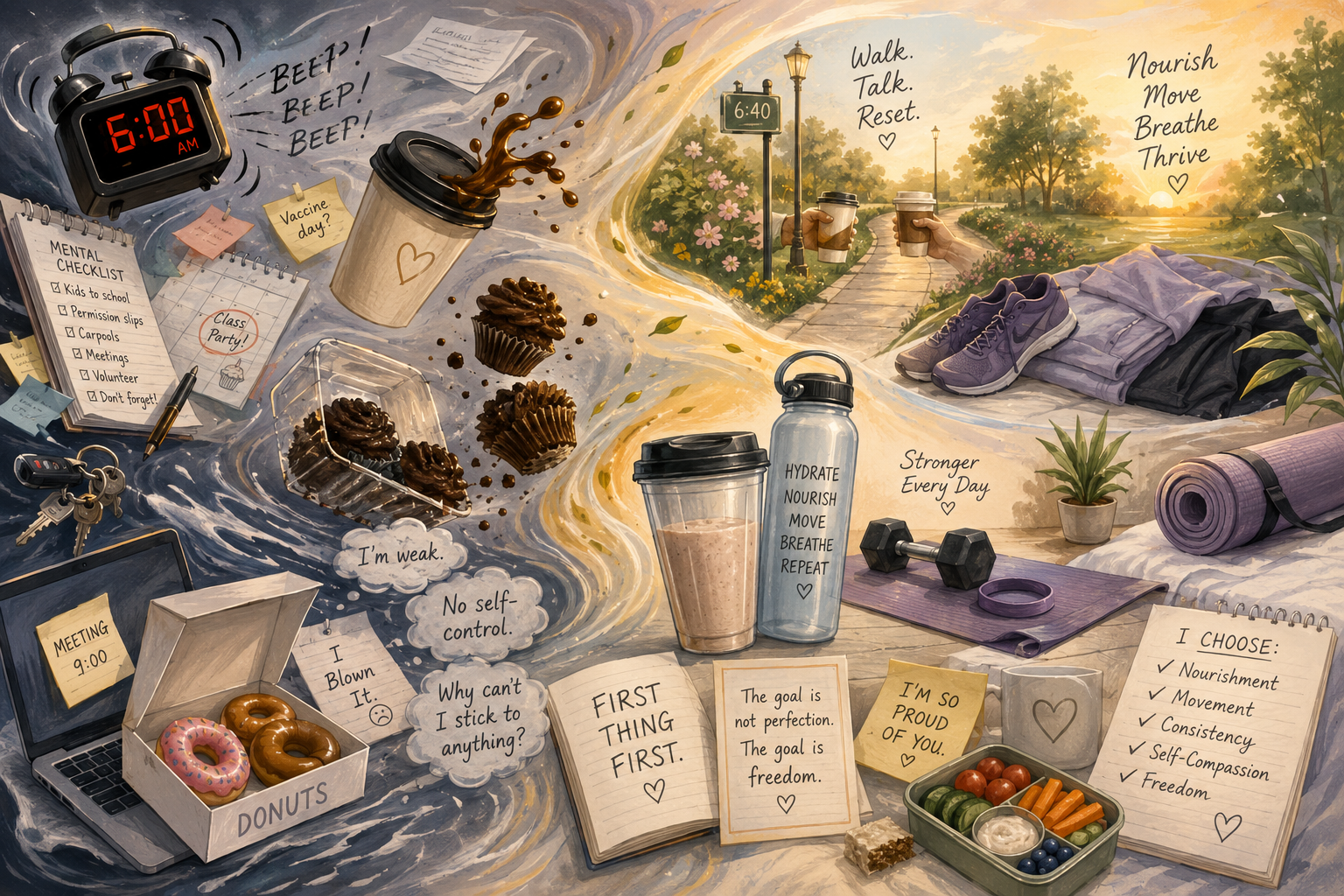
The alarm sounds at 6:00 a.m. Your eyes slowly open as the reality of another busy day settles in. A mental checklist begins to unfold: get the children ready for school, sign permission slips, remember who needs what for class, coordinate carpools, and somehow arrive at your first meeting by 8:30.
The thoughts come in waves. Is today vaccine day at school? Which child has a class party? What did I volunteer to bring? The sheer volume of it feels overwhelming.
Then you remember the hot cup of coffee waiting in the kitchen, a small comfort before the demands of the day.
As your coffee brews, you notice a container of leftover chocolate cupcakes from your daughter's school birthday. Chocolate cupcakes are your favorite, and they would pair perfectly with your coffee. You know they are not part of your plan, but you're exhausted. You barely ate dinner last night after getting home late from your daughter's gymnastics performance. A cupcake feels harmless. Maybe even deserved. Would one cupcake really make a difference?
Before you fully realize what is happening, you've eaten two alongside your coffee. For a brief moment, the anxiety quiets. The mental chatter softens. You feel relief.
Then your husband walks into the kitchen. He glances at the cupcakes. "I thought you were trying to eat healthier? Aren't we paying for a gym membership and a diet coach?"
Instantly, the relief is replaced by guilt. How could I do this? You have been trying so hard. Determined to regain control, you promise yourself: no more treats today, nothing for the rest of the week, you will make up for it. This was just a mistake, and it won't happen again.
The day continues. You rush to get dressed, prepare lunches, get the children out the door, and make it to work. In the chaos, you skip lunch for yourself. After all, you've already blown it.
As your meeting drags on, the donuts in the center of the conference table become harder to ignore. You resist. You can wait until lunch. But your body has other plans. By noon, you're shaky, lightheaded, irritable, and unable to focus. Your brain is no longer concerned with willpower or long-term goals. It wants energy, and it wants it now.
The moment the meeting ends, you head straight to the café and order far more than you meant to. Moments later, everything is gone.
And once again, the shame arrives in waves. How did this happen? You promised yourself this morning would be different. You imagine your coach's disappointment, your husband's frustration, your mother's concerned look at the upcoming family wedding. The inner critic takes over.
I'm weak. I have no self-control. Why can't I stick to anything?
BEEP! BEEP! BEEP! WAKE UP!
You hear your alarm clock beeping beside your bed. Slowly, your eyes open. As you take in your surroundings, you realize your cheeks are wet with tears from the dream you were just having.
How long will these dreams of what feels like a past life last? At least once a week you travel back in your sleep to what life looked like before you learned to regulate yourself without using food as a reward.
Today you wake with a plan, and with excitement instead of dread.
Your exercise clothes are folded over your gym shoes at the end of your bed, where you left them last night. Your body already knows what comes next. You pull the soft cotton over your head, lace up your shoes, and zip your hoodie, and you feel a little lighter, as if you are wearing a suit of armor.
The thoughts about the day come and go like waves lapping the shore. They can't touch you yet; it is not their time. You repeat your affirmation, "first thing first."
Yes, there is so much on your plate, an endless list of obligations, but all of it will wait until you take the time you need to put yourself first. Your walk with your best friend and your yoga mat come first today.
In the kitchen, you start with nourishment: a blender of protein powder, coffee, ice, and milk. Then, water in one hand and coffee in the other, you head out to meet your best friend at the corner, where she waits every morning at 6:40. She knows all the ins and outs of your life, and as you walk and talk, your heart rate rises and your mind quiets. The worries that tried so hard to knock you down this morning become a little more manageable.
After your walk, you head in for a quick stretch on your mat and some strength training. You're running a bit late, but that's okay. You remind yourself that not every workout is perfect, and that the goal is just to be consistent.
It's amazing how far you've come in eight months. When you started, you could barely get down on the mat. Now you sit comfortably in your body in any position, and no matter what you ask of your muscles, they respond with a resounding, "we will try!"
When you finish, you stand at the end of your mat with your hands over your heart and an overwhelming sense of well-being. Whatever this day throws at you, you know you can meet it with calm.
Your husband walks by as you roll up your mat and gives you a wink. "I've noticed how hard you've been working. I'm so proud of you. You have a calmness about you I haven't seen in years. I think I might start waking up early to walk too."
After showering and dressing, you pack lunches, offering the kids some nutritious options and one snack from the drawer. Then you head out the door, ready to meet whatever the day holds.
You are not just surviving. You are thriving.
The goal is not perfection. The goal is freedom.
Understanding the Biology of Behavior
The inability to follow a food plan consistently is not a moral failing. It is not weakness, laziness, or a lack of discipline. It is biology.
Behaviors we label as failures of willpower are often the body's attempts to restore balance.
Your brain's first job is not to help you lose weight. It is to keep you alive. When it senses a threat, whether stress, exhaustion, overwhelm, dehydration, or low blood sugar, it shifts into survival mode, and your careful intentions give way to its urgent need to restore balance. Behavior is often the visible result of an invisible biological process.
When we begin the day dysregulated, sleep-deprived, and overwhelmed, and then reach for highly rewarding foods to soothe ourselves, we create a cycle that is hard to escape. Over time, the brain learns that these foods bring rapid comfort and craves them more intensely, not because of a character flaw, but because it is doing exactly what it was designed to do.
A sustainable approach begins with understanding how biology, behavior, and emotion work together. When we learn to meet the body's needs, we no longer rely on willpower alone. Food becomes nourishment rather than a coping mechanism. That is freedom: from constant food thoughts, from shame, and from the exhausting cycle of restriction, overeating, and self-criticism.
This is the heart of the work I do as a nurse and psychotherapist: helping people uncover the biological, behavioral, and emotional factors behind these patterns, and building steadier ways to meet the body's needs, form a healthier relationship with food, and handle life's challenges without turning to food to cope.