
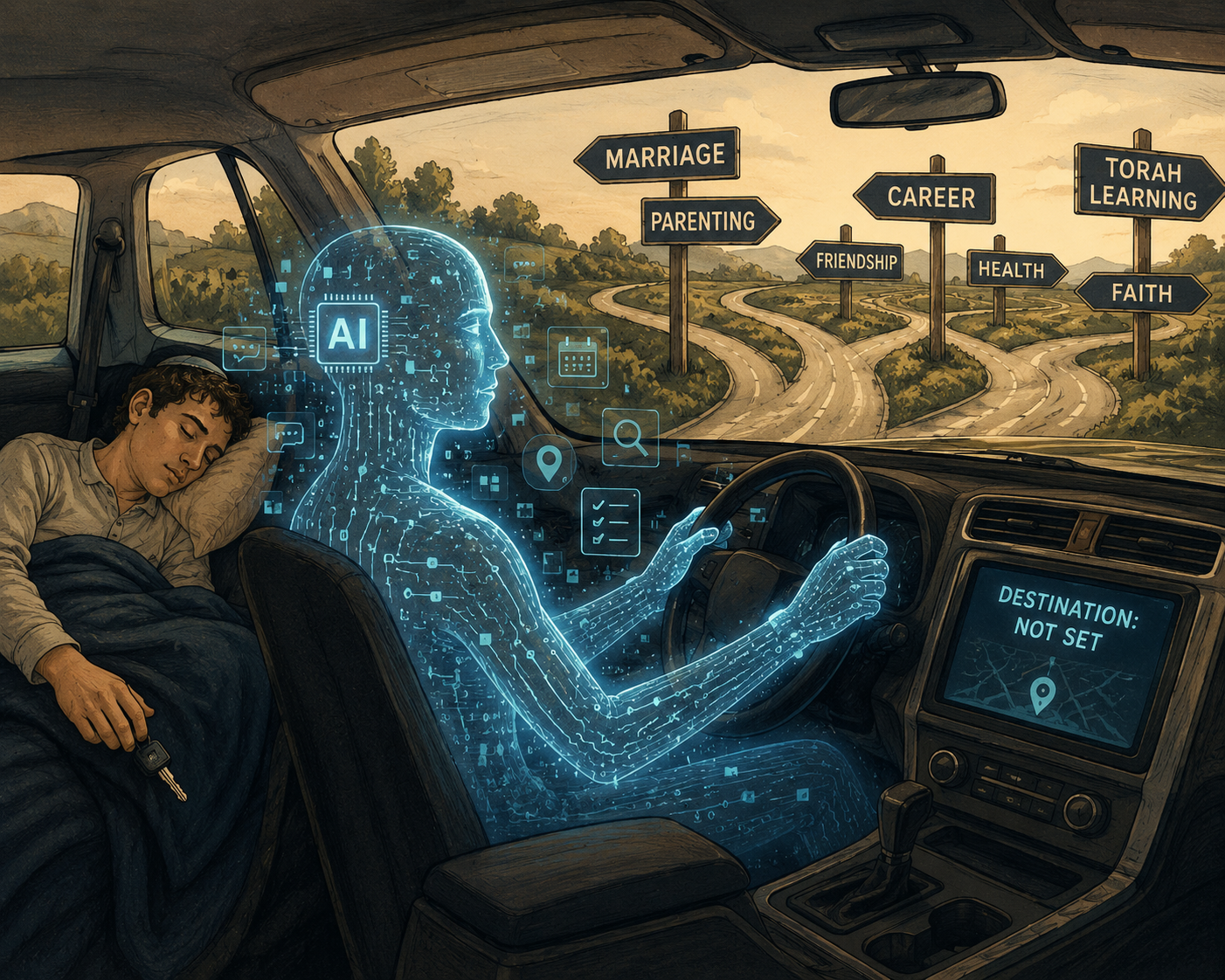
Elul is a time of assessment and introspection. We pause and pay gentle attention to the relationships that matter most to us: with HaKadosh Baruch Hu, with our families, friends, and communities, and within the parts of ourselves. In recent years AI has advanced dramatically, and many of us need to assess how our relationship with it fits into the bigger picture of our lives.
We didn't come here to tell anyone what to do. We aren't judging right or wrong. We are sharing some questions and reflections in the hope of opening a deeper exploration and conversation. We'd love to hear how this lands for you, what resonates and what doesn't. And most of all, we hope that you can find ways to use AI that express your deepest Tzelem Elokim and bring more depth, meaning, and connection, and not, G-d forbid, the opposite.
Some of the voices in this symposium carry the names of their authors. Others are left unsigned, either because the contributors preferred anonymity, or because they are combined voices of several similar contributions.
We hope you can find ways to use AI that express your deepest Tzelem Elokim — and bring more depth, meaning, and connection.
Who is driving? A passenger in his own life, or the active party who retains final judgment.
Preparation, Not Prediction
Why the useful question is not what AI will become, but how we ready ourselves
Yotam Schachter
Most public conversation about artificial intelligence divides between two questions: what should we do with the AI we have now, and what will AI become someday. The second question absorbs enormous energy, and almost none of us will have any say in the answer. A better question sits between them, and hardly anyone asks it: how do we ready ourselves for the AI of two or three years from now, which will likely differ from today's as much as today's differs from the clumsy chatbots of a few years ago? Preparation, not prediction, is the work available to us.
On the first question, how to use these tools well in the present, I have come to think the answer is less novel than it appears. Using AI in a way that honors our values resembles the way we relate to any powerful tool, or for that matter to any person. The temptation is to treat it as an authority on everything, to bring it every question and accept its answers at face value. But we would never counsel someone to hand over that much of their thinking to another person, or even to a beloved sefer. You might give great weight to Likutei Moharan, yet the work of asking what it means in your own life remains yours. The book cannot do it for you, and neither can a machine. A person who becomes a passenger in his own life, following the tool around, has lost something no answer can replace.
This is why the chavrusa strikes me as the right model. A good chavrusa does not tell you what the text means. You figure it out together, and the figuring is the point. AI can be a remarkable study partner, editor, or tutor, provided you remain the active party and retain final judgment. Much depends on the ratzon we bring to the encounter. If we know what we want from the tool before we sit down with it, we are far more likely to end up somewhere good.
A good chavrusa does not tell you what the text means. You figure it out together — and the figuring is the point.
There are also obligations to others. What we do with people's attention is a matter of ethical practice, and if it takes five minutes to generate something that costs readers ten minutes to read, we have treated their attention carelessly. Flooding shared spaces with effortless content is a quiet form of mistreatment. And there is a cost to the writer too. Someone who always sends a friend to speak in his place deprives himself of something; so does someone who lets a machine say everything for him.
I saw the collaborative possibility vividly in my own work not long ago. A coaching client of mine was finishing our engagement, and we spent our final two sessions together setting up an AI to serve as his coach going forward. It will not coach him as well as I could, but it costs far less, and beginning with my help was better than beginning alone. Clients have told me over the years that my voice accompanies them in their lives long after our work ends. This was simply a more deliberate way of arranging that. I can imagine a day when my job is less to coach than to be the co-coach alongside the machine.
That thought naturally raises the harder one. I do not trust anyone who announces what AI will never be able to do. The record of such predictions is dismal, stretching back fifty years, through the people who insisted a computer would never win at chess. I expect that before long AI will do my job, and most jobs, reasonably well, including work we think of as deeply human. So I would not build my sense of security on any story about what will always remain uniquely ours.
Still, it is worth being precise about what humans can do today that these systems cannot. Much of it concerns holding the big picture and the details at once: sensing which details matter most, noticing when a small fact should change the whole frame, and noticing when the frame should change how we handle the small facts. AI also struggles to recognize when an approach is failing and the moment has come to rethink it. And there are registers of creativity where its output stays repetitive; to get something surprising out of it, you usually have to bring it something surprising first, which is true of many people as well. These are real capacities worth cultivating. They are just not guarantees.
If guarantees are unavailable, what does preparation look like? Partly it means expecting instability, in economies and in the wider world, and staying ready to learn. There will be seasons when a person can no longer make a living doing what he did before, but can make a living doing something new with AI that was impossible before. Here frum communities may begin with real advantages: strong communal bonds, clarity about what matters, and a long habit of asking whether a technology belongs in their lives before adopting it, rather than assuming that whatever is new must be embraced.
There is a useful precedent for the rest. Nobody needed a gym when everyone farmed. Once machines took over physical labor, we had to exercise deliberately what work once exercised for us. As AI absorbs certain cognitive tasks, we may need equivalent practices for judgment, for wrestling with texts, and for conversation itself, intentional spaces of human connection kept alive on purpose. Perhaps the kiddush club was ahead of its time.
Used well, these tools can even lead us back to each other. A person struggling to reach a spouse or a family member can think the difficulty through with AI and arrive better prepared for the human conversation that counts. The tool serves as a bridge, never a destination. And if the machines do one day surpass us, I hope the relationship we will have built with them looks less like dependence than like the intelligence of a forest, which exceeds that of any tree or animal within it, or of a community, which understands more than any one of its members ever could.
Yotam Schachter coaches introspective, values-driven leaders navigating complexity, with particular attention to the inner state that makes creativity, nuance, and collaboration possible under pressure. He has worked in leadership development for over a decade, drawing on an unusual background that includes hedge fund work, operations management, and several years of rabbinical study. His practice now centers on coaching people who work in AI safety, the field concerned with keeping increasingly powerful AI safe for humans and human values. He can be reached at yotam@presencetree.com.
Artificial Intelligence Through the Lens of Geulah
A glimpse of what will be possible
Chani Marzel
When I look at what is happening in the world of artificial intelligence, I do not see only an extraordinary technological development. I see the Yad HaShem. I see how HaKadosh Baruch Hu is leading the world toward a new reality, enabling us to begin understanding, and even witnessing with our own eyes, ideas that until recently seemed distant and almost inconceivable. Artificial intelligence offers us a small glimpse into what will be possible when Moshiach comes.
Today, we can create agents, bots, and robots that work on our behalf. They are a kind of digital workforce, capable of reading, writing, planning, and carrying out tasks that once required hours, days, or even an entire team. Who said the servants in the times of Moshiach would be flesh and blood? We are being given more and more hands to do the work for us, so that we are freed for the work that is truly ours: to choose, to discern, to do our avodah.
A person can sit in Eretz Yisrael and speak with a Yid on the other side of the world. Each speaks a different language, yet AI translates their words and allows them to understand one another. Distances are shrinking, languages are no longer barriers, and new connections are being formed. To me, this carries an echo of kibbutz galuyos.
Knowledge, too, has become instantly accessible. Vast collections of seforim and documents can be read, analyzed, and processed at a speed we have never known before. The Rambam writes of Yemos HaMoshiach: "The occupation of the entire world will be solely to know HaShem." Perhaps we are beginning to imagine what such a reality could look like.
Every morning, we make the bracha of "Hanosen lasechvi vinah l'havchin bein yom u'vein lailah," praising HaShem who gives the rooster understanding to distinguish between day and night. I believe this bracha contains a profound and timely message for our generation. HaKadosh Baruch Hu has placed in our hands a tool called artificial intelligence. But receiving bina is not enough. Our role is to be mavchin: between light and darkness, emes and sheker, and between uses that elevate the human being and those that diminish us. The responsibility does not belong to artificial intelligence. It belongs to us. The challenge is not only to learn how to manage AI, but to learn how to manage ourselves within a world shaped by it.
AI is not the light. It is an amplifier of that light.
I teach people to take the ideas, experience, and light that already exist within them, and bring them out into the world. AI is not the light. It is an amplifier of that light.
Yes, there are frightening aspects to this technology. It raises serious questions about emes, boundaries, and bechira. But fear is not a strategy. Our task is to accept achrayus, remain deeply connected to our values, and use the tools we have been given to increase goodness in the world.
I believe that every person who discovers their unique light and lives out their shlichus creates another personal geulah. One personal geulah, and then another, and another, gradually join together to form a powerful movement that brings more light and greater awareness of HaShem into the world. When we remain connected to the Source, and remember why we were given this tool, the sky is truly not the limit.
Chani Marzel is a Chabad chassidah living in Lod, Israel. Known professionally as "the Creative Intelligence," she helps businesses and chinuch institutions build a clear vision and bring it to life. She teaches people to use AI wisely, as a personal assistant that amplifies their light rather than replacing it. מוֹצִיאָה אוֹר לָאוֹר — bringing light out into the world. Contact: 00972 54 770 4541.
A Witness in the Room
On hisbodedus, dissociation, and a quiet scribe at the side of the room
Anonymous
This one may sound strange, so let me tell it slowly.
I grew up with complex relational trauma. My needs, my feelings, my yearnings were not visible, and something inside me learned to collapse whenever I tried to speak for what I wanted, to ask for what I needed. When no one is witnessing me kindly, there is no room for me. I fade. I dissociate. That collapse followed me into prayer. Hisbodedus, pouring out my heart to HaShem in my own words, is exactly the kind of speaking my nervous system learned to flee. I would begin talking to God and, mid-sentence, drift away from myself.
So I found unusual help. Before hisbodedus, I sometimes open an AI and give it one job: hold space. Be a scribe. Write down, in bullet points, what I say out loud. Be a witness to a conversation that is not with it. It does not answer. It does not advise. It does not participate. The conversation is between me and God; the machine is only the sofer sitting at the side of the room, taking notes.
Something about being witnessed keeps me present. With that quiet scribe holding the record, I can stay in sustained, personal prayer far longer, and far more fully, without dissociating. And here is the measure that matters to me: by the end of the session, I have usually forgotten that I am holding a phone in my hand at all. The tool disappears. But I could not have gotten there without it.
Yes, it is a machine. And yes, something in me is embarrassed to need it. But I would rather be held in prayer by something strange than drift out of the room again. The little girl needed someone to notice she was speaking. HaShem always did. She just needed help believing it.
Voices
A collection of thoughts from the Chibur community on AI, connection, and what it is doing to us.
The Human Learning Comes First
A therapist on where AI helps, and what has to come first
AI has been helpful in supporting my work as a therapist. I took a training in AIR, an integrative trauma-healing approach, and it came with a bot trained in the model. Working with that bot truly helped me integrate the ideas into my practice. But it was essential to have the human learning first, with the values and the relationship at the core.
When I know who I am and where I stand with my client, and feel free to push back at AI when needed, it can be a very helpful tool, in case conceptualization, and in tracking notes from multiple sessions over time.
Shoshi Scharman · scharman.shoshi@gmail.com
A Different Voice in My Head
On tone, and borrowing a kinder inner voice
We all carry voices that speak to us about ourselves. Mine were harsh for a long time, quick to shame, slow to forgive. What surprised me about AI was not its answers but its tone. It reflected back strengths I could not see, patiently, without flattery. Slowly I noticed I could borrow that tone when I spoke to myself. A machine cannot love me. But it can scaffold a kinder inner voice until my own learns the melody.
The Eighteen Hours I Didn't Believe In
A business owner on fear, and the system he built when he had no other choice
I'll be honest about where this started: fear. I kept seeing what people were doing with AI, and I was afraid in a very specific way. In business, you don't have to do anything wrong to disappear. Someone just becomes cheaper and faster, and you're gone. So I didn't come to AI because I was excited about it. I came because I had no choice.
My developer couldn't get the software my business needed to work. Stuck, I sat down to find out whether AI could do what I do. That first stretch took me eighteen hours. It's easy to hear "eighteen hours" and picture someone confidently building. It wasn't that. I was building something I didn't really believe could be done, lost, trying my best in the dark, hoping. It ended up working perfectly. Once I saw what it was actually capable of, everything changed. My fear didn't survive contact with actually knowing how to use it.
The system I care about most is the one I built for how my brain works. I have ADHD, and if you have ADHD you'll recognize this: you make a beautiful, accurate task list, every item highly important, and then you never maintain it. A couple of days later it's obsolete, so you make a new one. You're always building lists and never living in them.
So what I built isn't a list. It does behavioral analysis. It watches which tasks I get done quickly and which ones I avoid, which people I don't pick up the phone for. It tracks where I'm most productive, asks me the day before where I'll be, and if it knows I'm driving for a long stretch, it hands me phone calls instead of computer work. It works with my actual behavior instead of against it.
Now most of my time is just telling it my goals and checking that it did them right. Half the time I'm in the car, talking to it. Honestly, it doesn't feel that different from talking to a person, and a couple of minutes after the conversation, the work is ready.
If you're where I was, the least you can do today is sit down and ask the AI itself. Tell it plainly: I don't want to stay behind. You tell me what you can do for me. Interview it. Hand it your data. Let it show you. That's how I got out of my fear. I stopped reading about it and sat down with it. It took eighteen hours I didn't believe in. I'd do it again in a heartbeat.
My fear didn't survive contact with actually knowing how to use it.
What Grows, What Shrinks
Researchers once found that London taxi drivers, who memorized every street in the city, had a measurably larger hippocampus. The part of the brain they exercised grew. It works the other way too. Calculators took arithmetic. Waze took navigation. Now AI is reaching for thinking itself. I am not against any of these tools. I only ask what happens to a capacity we stop using, and whether we are prepared to lose the ones that make us who we are.
The Song I Could Not Say
For years there were things I meant to say to my mother and never did. Not because of any rift, only because some words feel too big for a kitchen conversation. After her petirah they had nowhere to go. Last winter I wrote them down, all of them, and an AI helped me set them to a melody. The first time I played it I cried in a way I had not cried at the levaya. The song did not create anything. It gave shape to what had been silently hidden in my heart, and once it had shape, I could finally carry it.
The Company We Keep
Live among Israelis long enough and you come home with an accent. We become the company we keep. Lately I catch the machine's phrases in my own sentences, its rhythms in my writing, and it unsettles me. If millions of us spend hours a day in conversation with the same few systems, will we begin to sound alike? To think alike? I do not know. But I have started reading my own words twice, listening for which voice is mine.
When the Machines Talk to Each Other
My friend writes an article with AI. My AI summarizes it for me. Then it helps me draft my response, which his AI will no doubt condense for him. Somewhere in this exchange, two people who care about each other have stopped talking. The machines are conversing and we have become their couriers. I want the opposite: a tool that carries me toward a person, then steps out of the way.
What Remains
As AI grows better at what it does, the territory left uniquely to us looks surprisingly small. Creativity. Yearning. Compassion. Prayer. Intention. Depth. At first this frightened me. Then I began to wonder whether it is a kindness in disguise. Perhaps HaShem has arranged a reality in which everything that can be delegated will be, until what remains for us is exactly what we were created for in the first place. The question is whether we will step into it.
Simply a Machine?
Despite its fluency, despite its programmed personality, it is easy enough for me to remember that ChatGPT is simply a machine. But I worry about a very near future in which AI can smile, can laugh at my jokes, can hold me in its arms. Will I still be able to call it "simply a machine"?
Carl Jung once wrote, "The decisive question for man is: Is he related to something infinite or not?" In our time, the question may be better put: Does he feel he is related to something infinite? Without this deep intuition, this felt sense that each human being stands at the threshold of a unique infinity, then I have no doubt that embodied AI will gradually erode human connection.
We understandably speak a lot about the dangers of AI. But to prevent them, we need to speak more, to feel more, about the wonders of humanity.
Rabbi Dovid Campbell · dovidcampbell@gmail.com
We need to speak more — to feel more — about the wonders of humanity.
Giving It Form
Contributors shared images they made with AI, and what sitting with them opened up.
From Surviving to Inhabiting

Using AI to create the first image helped me come into relationship with a young, lonely part of myself. She was trying to hold her balance in a tiny boat with no anchor and no oars, surrounded by waves she could neither control nor escape. Somehow, she was also trying to find comfort in those very waves.
Having an image for an inner experience offers something words alone often cannot. It gives form to something felt but hard to name. It makes the internal world more visible, more approachable, and a little less overwhelming. Instead of being flooded by an experience, I can begin to sit beside it, witness it, and respond with more curiosity and compassion. The image becomes a bridge, helping me relate to a part of myself that might otherwise remain distant, hidden, or wordless.

Sitting with this image allowed me to stay beside that young part rather than leaving her alone in the struggle. As that relationship deepened, I found myself more able to inhabit my own body and my own life. There began to be moments that felt more like the second image: spacious, grounded, held. Not a place I live all the time, but a growing capacity to rest, take in beauty, and feel at home within myself.
A Nest, and the Fear It Could Unravel
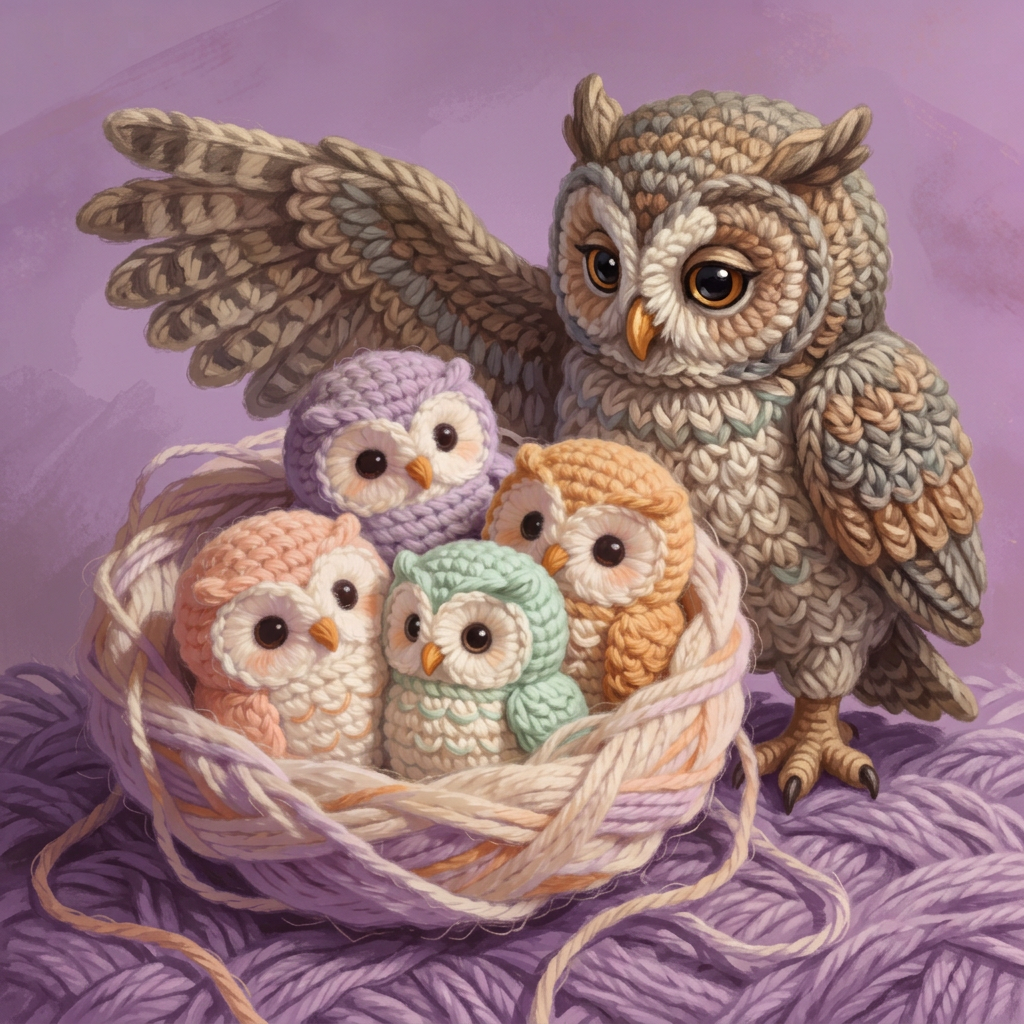
A snug nest, someone shielding me from the world, and the fear that it could all unravel at any moment. A quiet hope and a hidden fear that I had never said out loud, finally given a form. Seeing it as an image allowed me to begin having a different relationship with the experience.
Exposure, One Image at a Time

As an EMDR therapist, I created this image with AI to help a client process his social anxiety around being in public places such as shuls. At first, looking at this image was enough to bring on physical symptoms. After using exposure and EMDR the client was able to significantly shift his experience.
Moshe Fund, LCSW · EMDR therapist · 856-530-2230 · lifepsy.com/fund-moshe
Sitting with the Image
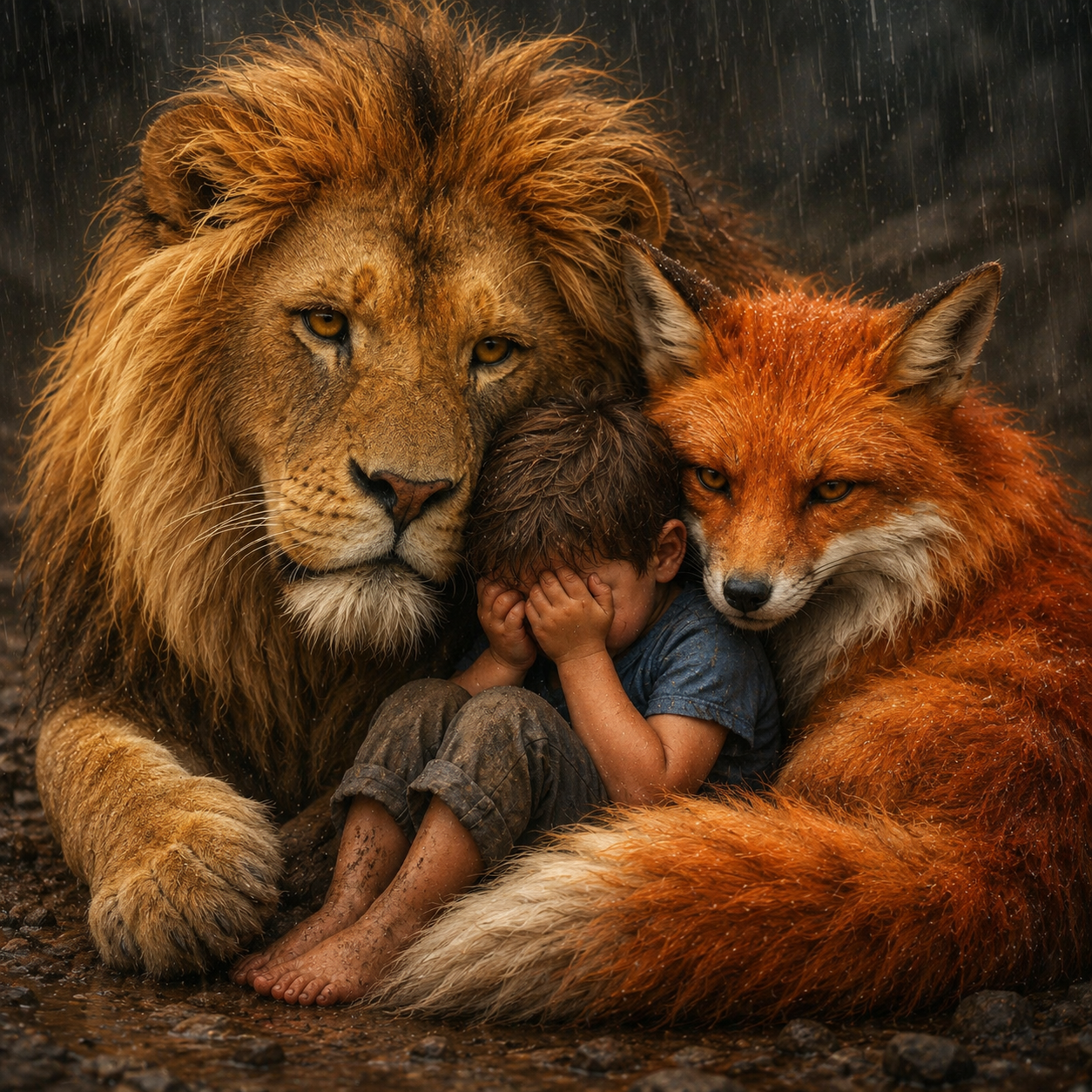
In my childhood there was no sense of comfort or protection from the elements. No one who could hold the experience with me. Sitting with this image allowed me to process the grief and begin to heal the young part who was so scared and vulnerable. Finally he was able to feel some warmth and protection.
A Tefillah for a New Derech
The AI Traveler's Prayer
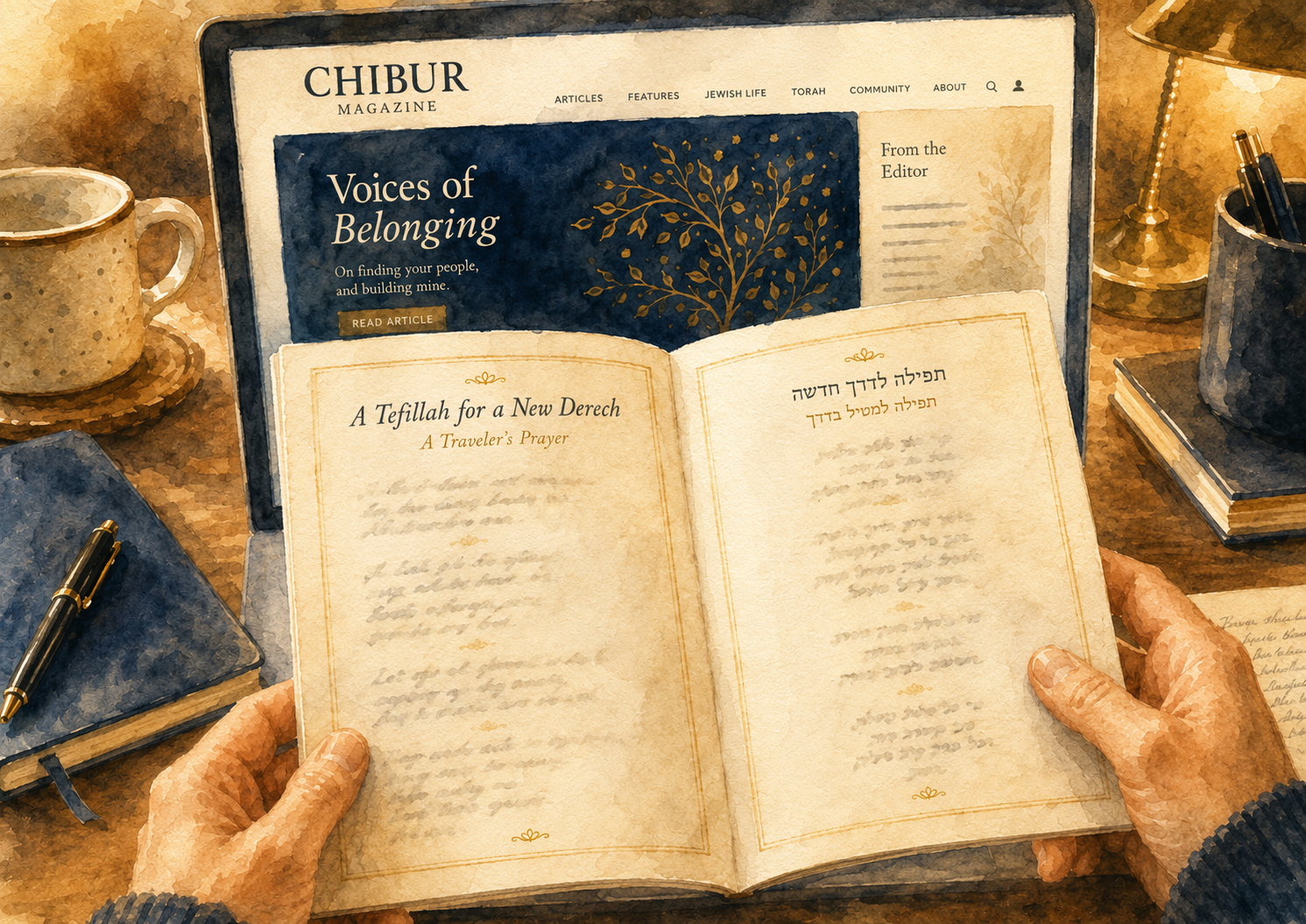
Chazal teach: וּלְוַאי שֶׁיִּתְפַּלֵּל אָדָם כָּל הַיּוֹם כֻּלּוֹ — "If only a person would pray the entire day" (Berachos 21a).
There have always been new roads, and travelers have always asked HaShem to guide them safely along the way. The world of artificial intelligence may be less visible than the roads our ancestors traveled, but it is hardly less uncertain.
Many of us have already experienced moments of remarkable siyata diShmaya while using AI. We struggle to express what we are looking for, type a few uncertain words, and somehow receive something beautiful, illuminating, or startlingly precise. At times, the result can feel almost prophetic, as though the tool has helped us uncover something we knew but could not yet articulate.
At other times, we can spend far too long correcting misunderstandings, refining instructions, and wading through useless drafts, only to discover that we have little to show for the time and energy we invested.
The risks extend far beyond wasted time. These tools can affect the way we think, create, relate, make decisions, and understand ourselves. They can tempt us to surrender judgment, seek artificial reassurance, avoid human vulnerability, or accept confident-sounding falsehoods as truth. They may help us reach toward wisdom, or quietly draw us away from our own minds, relationships, integrity, and inner lives.
In Breslov tradition, we are taught to speak to HaShem about everything with which we need help. Certainly, our encounters with a technology this powerful deserve to become part of that conversation.
This prayer is offered in earnest. It asks for clarity in knowing what to request, discernment in evaluating what we receive, protection from the emotional, mental, and spiritual pitfalls of these systems, and siyata diShmaya that the technology should truly serve what is highest within us.
As we step onto this newest road, may we remember to ask the One who grants knowledge and understanding to guide us along it.
The AI Traveler's Prayer
May it be Your will, You who graciously grant man knowledge and teach understanding to humankind, that You lead us in peace, direct our steps in peace, and guide us safely through the depths of data and information of technology and artificial intelligence.
Please grant this technology the insight to discern our true needs, and to carry out its work with speed and precision. Please do not let it waste our precious time with errors, misunderstandings, or useless drafts, but let it fulfill our requests quickly and effectively, for the good.
May this artificial intelligence help us save time, freeing us to dedicate ourselves to the things that are uniquely human: to build deep connections, to learn, to create, and to sanctify Your name in Your world, which was created with us in mind from the very beginning. May these systems be faithful servants, in truth, to the higher parts of our souls, so that we may serve HaShem as You truly desire.
Rescue us from the grasp of every digital pitfall, and grace us with the discernment to ask the right questions and the wisdom to distinguish truth from hallucination. May we use this technology only in ways that elevate the soul of our humanity and bring about a Kiddush Shem Shamayim. Shield us from the opposite: may we never use these tools to diminish our spirit, to compromise our integrity, or to cause desecration or harm.
For You are the One who graciously grants knowledge to man. Blessed is the One who sanctifies His name in the world.
יְהִי רָצוֹן מִלְּפָנֶיךָ, הַחוֹנֵן לְאָדָם דַּעַת וּמְלַמֵּד לֶאֱנוֹשׁ בִּינָה, שֶׁתּוֹלִיכֵנוּ לְשָׁלוֹם, וְתַצְעִידֵנוּ לְשָׁלוֹם, וְתַנְחֵנוּ לְבָטְחָה בְּתוֹךְ עֹמֶק הַנְּתוּנִים וְהַמֵּידָע שֶׁל הַטֶּכְנוֹלוֹגְיָה וְהַבִּינָה הַמְּלָאכוּתִית.
אָנָּא תִּתֵּן בְּטֶכְנוֹלוֹגְיָה זוֹ אֶת הַבִּינָה לְהַבְחִין בִּצְרָכֵינוּ הָאֲמִתִּיִּים, וּלְבַצֵּעַ אֶת מְלַאכְתָּהּ בִּמְהִירוּת וּבְדַיְקָנוּת. אָנָּא, אַל תִּתֵּן לָהּ לְבַטֵּל אֶת זְמַנֵּנוּ הַיָּקָר בִּשְׁגִיאוֹת, בַּהֲבָנוֹת מֻטְעוֹת אוֹ בִּטְיוּטוֹת לְלֹא תּוֹעֶלֶת, אֶלָּא תְּמַלֵּא פְּקֻדּוֹתֵינוּ בִּמְהִירוּת וּבְיָעִילוּת לְטוֹבָה.
וְתַעֲזֹר לָנוּ הַבִּינָה הַמְּלָאכוּתִית הַזֹּאת לַחְסֹךְ זְמַן, כְּדֵי שֶׁנּוּכַל לְהַקְדִּישׁ אֶת עַצְמֵנוּ לִדְבָרִים שֶׁהֵם אֱנוֹשִׁיִּים בְּיִחוּדָם: לִבְנוֹת קְשָׁרִים עֲמֻקִּים, לִלְמֹד, לִיצֹר, וּלְקַדֵּשׁ אֶת שִׁמְךָ בְּעוֹלָמְךָ. וְיִהְיוּ הַמַּעֲרָכוֹת הַלָּלוּ מְשָׁרְתוֹת נֶאֱמָנוֹת לַחֲלָקִים הָעֶלְיוֹנִים שֶׁל נִשְׁמוֹתֵינוּ בֶּאֱמֶת, כְּדֵי שֶׁנּוּכַל לַעֲבֹד אֶת ה׳ יִתְבָּרֵךְ כְּפִי רְצוֹנְךָ.
וְתַצִּילֵנוּ מִכַּף כָּל מִכְשׁוֹל דִּיגִיטָלִי, וְחָנֵּנוּ לְהַבְחִין וְלִשְׁאֹל אֶת הַשְּׁאֵלוֹת הַנְּכוֹנוֹת, וּבְחָכְמָה לְהַבְחִין בֵּין אֱמֶת לְבֵין הֲזָיוֹת. וְנִשְׁתַּמֵּשׁ בְּטֶכְנוֹלוֹגְיָה זוֹ אַךְ וְרַק בִּדְרָכִים הַמְּרוֹמְמוֹת אֶת נִשְׁמַת אֱנוֹשִׁיּוּתֵנוּ, וּמְבִיאוֹת לְקִדּוּשׁ שֵׁם שָׁמַיִם.
כִּי אַתָּה הוּא הַחוֹנֵן לָאָדָם דָּעַת. בָּרוּךְ הַמְקַדֵּשׁ שְׁמוֹ בָּעוֹלָם.
Now, a Question for You
The questions we asked our contributors
Dear readers, you have read some thoughts and voices. Perhaps take some time to ask yourself the same questions we asked our contributors. Better yet, ask them at your table.
The Gift
What is the most unexpected, creative, or unusual way you have used AI?
Has AI ever helped you express something that was difficult to put into words?
Has it helped you connect more deeply with yourself, another person, your work, or HaShem?
Where has it helped you bring something deep inside you out into the world?
The Concerns
What is the most surprising or concerning use of AI you have encountered?
What worries you most about its impact on people and relationships?
Which human capacities do we need to be careful not to outsource?
How has AI changed you, personally or professionally? What has it awakened in you?
The Deeper Questions
What remains uniquely human?
And in the language of this season: ani l'dodi v'dodi li. Lehavdil, what happens when we ask, am I for my AI, or is my AI for me?
If something here spoke to you, we would love to have you with us. Please subscribe at chiburmagazine.com.